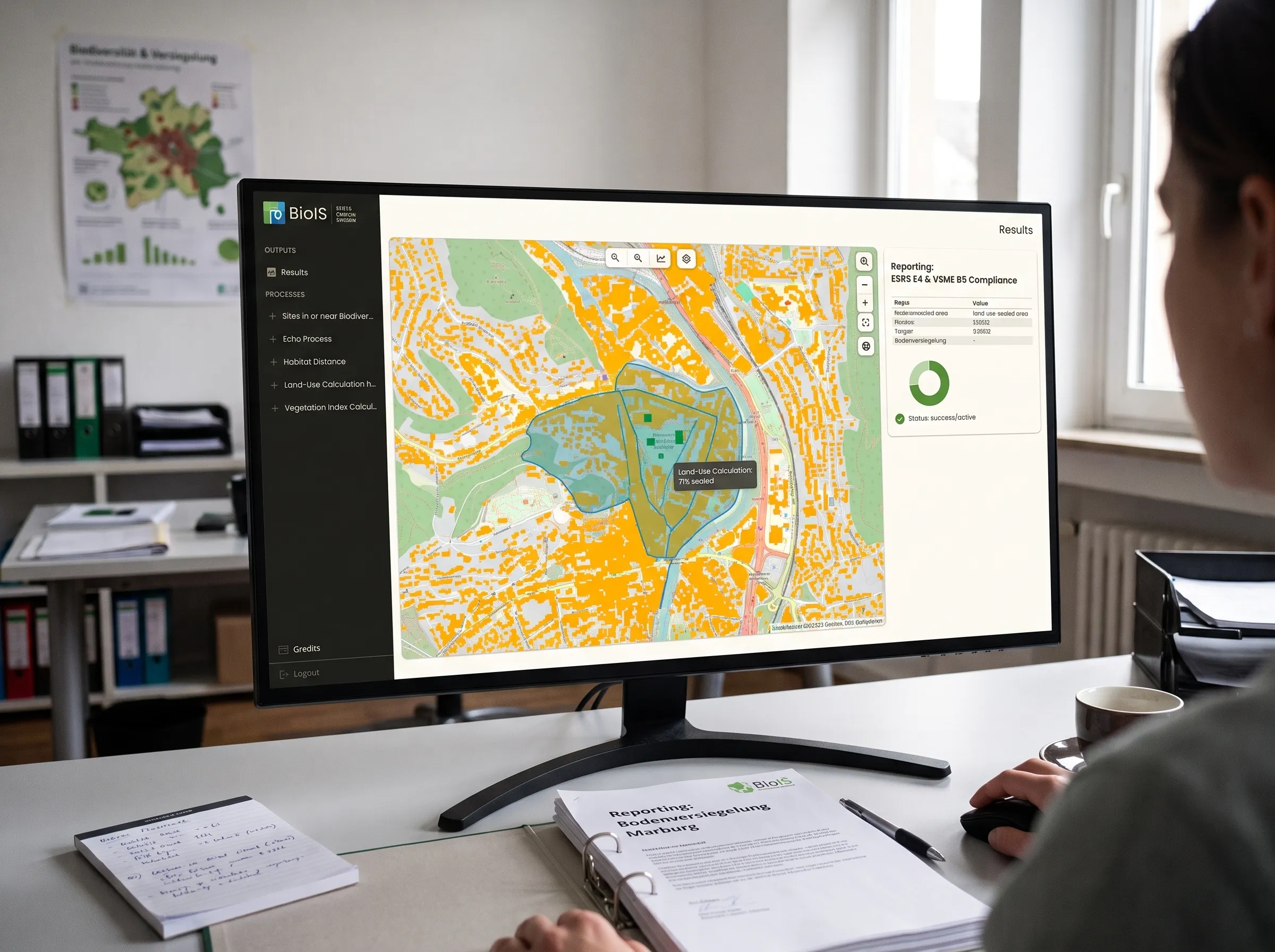
Symbolic image (office scene AI-generated). Map: © OpenStreetMap contributors, modified Copernicus Sentinel data (2026)
October 13, 2026
CSRD currently affects primarily large companies. But the reality is that more and more SMEs are receiving ESG questionnaires from their customers or banks.
The VS and VSME standards provide the right guidance to meet sustainability requirements efficiently, secure your market position in supply chains, and significantly reduce the time required to do so.
But ESG no longer ends with the carbon footprint: banks, customers, and auditors are increasingly demanding transparency about the impact companies have on their immediate environment. Soil sealing, heavy rainfall risks, and the loss of biodiversity are moving directly into focus — and with them the question of how much land a site actually occupies.
❓ How do you correctly calculate soil sealing and near-natural areas?
This is precisely the question many sustainability teams are facing. Both the VS and the VSME require concrete land use calculations in Module B5 (sections 53-54). The key question is: How many square meters of your premises are artificially sealed (e.g. by asphalt or concrete)? It is also relevant whether you own near-natural compensation areas, how large they are, and whether they are located on or next to the site.
📍 A concrete example
You operate a production site. In reporting, a rough estimate is not enough — exact figures in square meters (m²) are required for the total sealed area as well as for total land use.
In practice, collecting sealing data often fails due to the enormous effort involved: comparing building plans, manually tracing areas on maps, and painstakingly adding them up piece by piece.
🛠️ The solution: automated geodata analysis
This is where automated analysis comes in (for example with our tool BioIS):
- 📍 Upload sites and area types as geodata (by simply defining sites and near-natural areas).
- 🗺️ Automatically compare them with reliable documentation sources, such as the validated data from the European Copernicus programme.
- 📊 Export audit-proof summaries for reporting at the click of a button. Optionally, you can even compare the values of the reporting year with the previous year to directly report percentage changes in land use.
Conclusion
The land use requirements in VS / VSME B5 do not have to be a time drain. With the right tools, a complex area calculation becomes a clear, scientifically grounded statement for your sustainability report.
How are you currently determining the degree of sealing for your sites — manually or with digital support?
🔗 If you want to test BioIS for automated “Sealed Area” analysis, you can find all the information here: BioIS