August 18, 2026
CSRD currently affects primarily large companies. But the reality is that more and more SMEs are receiving ESG questionnaires from their customers or banks.
The VSME standard (Voluntary Sustainability Reporting Standard for SMEs) provides exactly that kind of clear, pragmatic framework for small and medium-sized enterprises. It creates transparency, strengthens the company’s role in the supply chain, and saves time when answering individual customer requests.
How biodiversity can be made tangible and measurable
This is precisely the question many sustainability teams are facing. The VSME standard addresses this in Module B5 under “Biodiversity Sensitive Areas.” The key question is: Are your operating sites located in or near ecologically sensitive areas?
📍 A concrete example
A logistics site is located 200 meters from an alluvial forest designated as a protected area.
In reporting, a general promise is not enough — exact data on distance, the affected area, and on-site environmental risks are required.
However, manually comparing business sites with protected area maps is time-consuming, error-prone, and difficult to document in an audit-proof way.
🛠️ The solution: automated geodata analysis
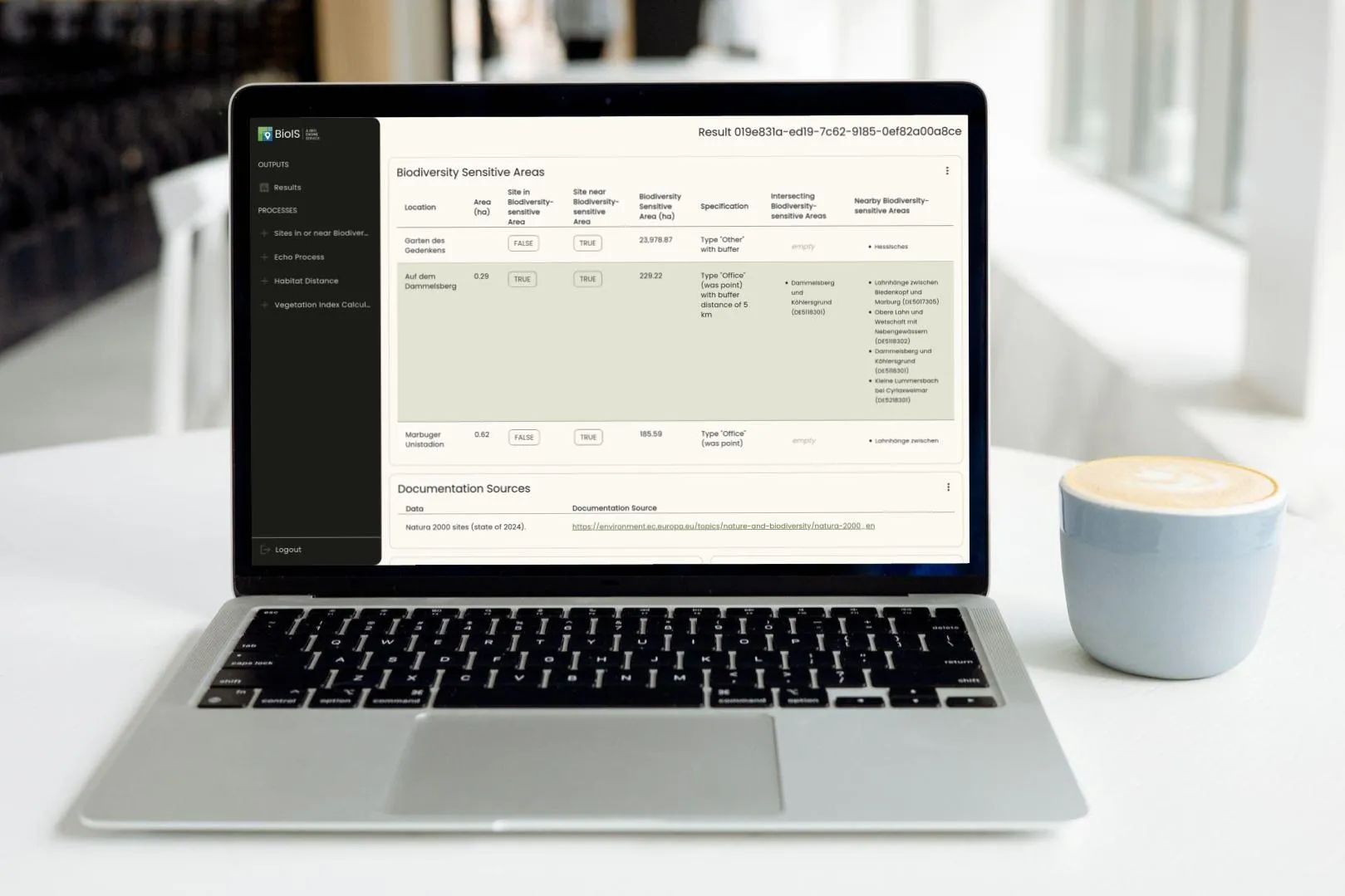
This is where digital analysis comes in (for example with our tool BioIS):
- 📍 Upload sites as coordinates.
- 🗺️ Automatically compare them with global protected-area databases.
- 📊 Export audit-proof indicators for reporting at the click of a button.
Conclusion
VSME B5 does not have to be a time drain. With the right tools, a complex question becomes a clear, scientifically grounded statement for your sustainability report.
How are you currently determining the biodiversity indicators for your sites — manually or with digital support?
🔗 If you want to test BioIS for automated VSME B5 analysis, you can find all the information here: BioIS